Breast Cancer Awareness Month is usually about getting screened. My story is about what happened after I did.
For years, when I looked back at the events leading up to my metastatic breast cancer diagnosis, I told myself a very simple story:
I missed the red flags.
I had a mammogram and breast ultrasound in Dubai in 2016. At the time, I was living and working overseas—I lived abroad from 2010 to 2017, but that is another story for another day.
They found something suspicious and recommended a biopsy.
Then I moved to Oman. Literally the next day.
I never got that biopsy.
Looking back now, after living with metastatic breast cancer for seven years and learning how to advocate for myself, I know exactly what BI-RADS 4 means. I know what dense breast tissue means. I know that a biopsy recommendation is not a casual suggestion.
But 2016 Allison didn’t know any of that.
And recently, I found the email threads.
Reading them changed the way I remember this part of my life.
Because apparently, I didn’t just shrug my shoulders and forget about the biopsy.
I tried to get it.
Over.
And over.
And over again.
My Dubai mammogram and ultrasound were done on August 31, 2016. I was 41 years old. The report documented my family history of breast cancer—my maternal aunt had been diagnosed in her early 40s.
The mammogram showed dense breast tissue that was masking detail.
The ultrasound showed something more concerning: a 14 x 8 mm mass in my left breast with irregular outlines.
The radiologist classified it as BI-RADS 4A and recommended a biopsy.
After moving to Oman, I started trying to make that happen.
On September 27, 2016, I emailed a private hospital:
“I had a mammogram done in Dubai and they are recommending for me to get a biopsy. Please see attached reports and I have AXA insurance. I would like to make an appointment.”
That should have been straightforward.
It wasn’t.
By October 4, I was writing again:
“Can someone please respond to my email? Or call me? This is the 3rd email I’m sending now, the first one I sent on Sep 18 to customer care and got no response.”
I attached my medical report again.
I gave them my insurance information.
I gave them my phone number.
I told them I wanted the biopsy.
Then I learned that I couldn’t simply schedule it. I first needed to see another doctor, who would review my report and submit paperwork for insurance approval if the biopsy was needed.
Fine.
I made the appointment.
At one point, I even wrote:
“I will pay cash first and get it reimbursed from my insurance.”
I saw the doctor.
She recommended that I get the biopsy.
Then I tried to schedule it.
Again.
The physician who performed the procedure was a visiting doctor who apparently came to the hospital only on Mondays.
On October 11, I emailed asking when my appointment would be.
On October 16, I followed up again.
On October 18, I wrote:
“I want to make an appointment … for a biopsy, this is the 3rd time I’m asking and already 2 Monday’s have passed by.”
And then, after yet another attempt:
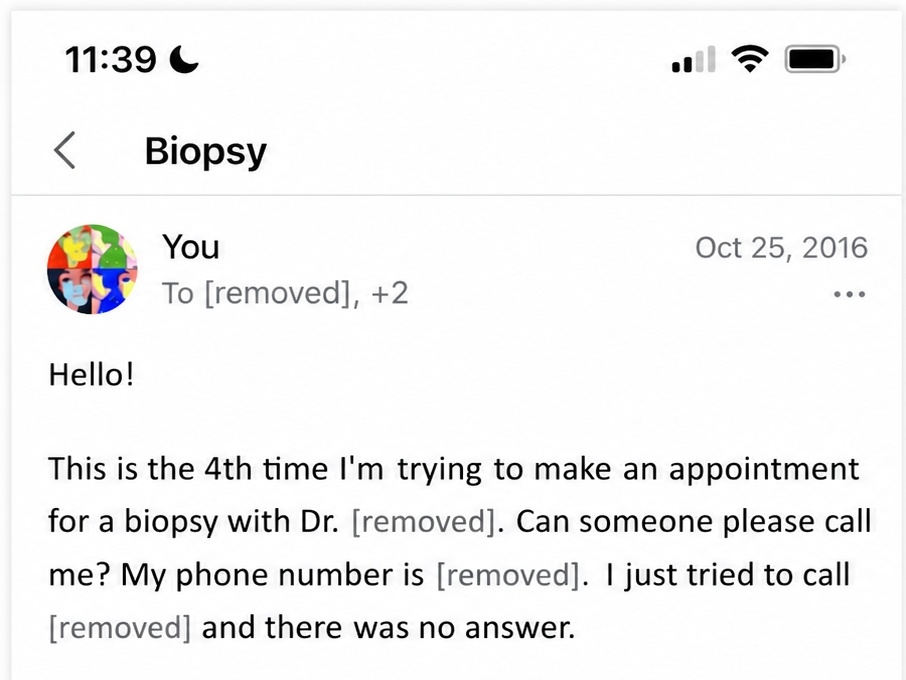
“This is the 4th time I’m trying to make an appointment for a biopsy. Can someone please call me?”
Eventually, I received a response explaining that the person I had been emailing couldn’t schedule the appointment herself because only the booking department had access to the visiting doctor’s schedule.
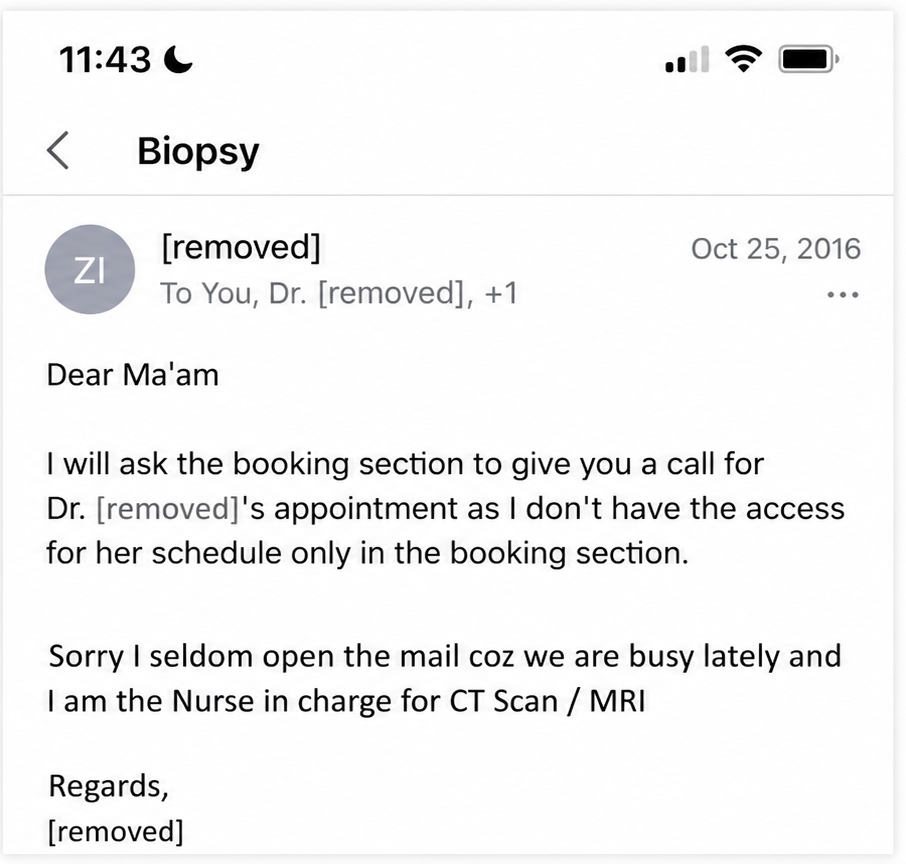
As I’m rereading that email now, I’m staring at it in disbelief.
Not because I think this nurse was a bad person. Reading the entire thread, she actually seemed to be trying to help me.
That’s almost what makes it more frustrating.
There wasn’t necessarily one terrible person refusing to help me.
There were unanswered emails.
A booking department.
An insurance approval process.
A doctor I needed to see first.
Another doctor who was only available on certain Mondays.
People who didn’t have access to one another’s schedules.
And me, the patient, trying to figure out how all the pieces fit together.
And what feels especially surreal looking back is that all of this was happening in October 2016, right in the middle of Breast Cancer Awareness Month.
Here comes October. Pink ribbons everywhere.
Messages telling women to get screened.
Messages about early detection.
Meanwhile, I had already been screened.
An abnormality had already been found.
A biopsy had already been recommended.
And I was sending email after email trying to figure out how to actually get the biopsy.
That is a part of the “early detection” conversation we don’t talk about enough.
Screening is not the finish line.
Finding something suspicious is not the finish line.
Even recommending a biopsy is not the finish line.
The next step still has to actually happen.
Eventually, I stopped trying.
And this is the part where hindsight gets complicated.
Could I have kept pushing?
Of course.
Could I have called another hospital?
Probably.
Could I have gone back to Dubai to get that biopsy?
Maybe.
Today, I would.
Today Allison would be calling every number she could find. She would understand exactly what BI-RADS 4A meant. She would ask whether the lesion had been seen on mammogram or ultrasound. She would want the radiology report. She would ask what kind of biopsy was recommended. She would not consider the issue resolved until someone explained exactly what happened to that lesion.
But I wasn’t that person yet.
I didn’t understand breast cancer.
I didn’t understand radiology terminology.
I thought a biopsy was something investigative that doctors sometimes ordered just to be extra careful.
And I was also in a period of my life when I wasn’t particularly proactive about my health.
So eventually, life moved on.
Then, in 2018, I was back in the United States and had another mammogram.
I specifically remember telling the tech that the doctors in Dubai had recommended a biopsy.
And I remember being brushed off.
I remember being told:
“You’re fine.”
That was exactly what I wanted to hear.
Deep down, 2018 Allison wanted the whole thing to be nothing.
I wasn’t thinking about breast cancer.
I wasn’t thinking, This is an unresolved suspicious finding.
I was thinking, I had another mammogram and they said I’m fine.
So I believed her.
Great. Box checked. I can move on with my life.
But here’s the part that really gets me now:
I didn’t completely forget about the old imaging.
When the imaging center asked me to get my old mammogram films from Dubai for comparison, I did.
I contacted the hospital in Dubai.
I filled out the release forms.
I obtained the images.
I sent them over.
And I received an email back saying:
“Thank you for getting the images. Even though your exam was normal we will still compare the new images with the old and issue an addendum.”
At the time, that reassured me even more.
Now, knowing what I know, I have so many questions.
Did anyone ask why a biopsy had been recommended?
Did anyone ever look at the written Dubai report?
Did anyone understand that the suspicious finding had been seen on ultrasound while the mammogram itself was limited by dense breast tissue?
Did anyone know that the biopsy had never happened?
I don’t know.
What I do know is that I had tried to get the biopsy overseas.
And when I came back to the United States, I brought the concern up again.
And somehow, I still walked away believing everything was fine.
For a long time, I carried this story as evidence of everything I “should have” done differently.
I should have known.
I should have pushed harder.
I should have understood the report.
I should have gotten the biopsy.
There will always be things I wish had happened differently.
But these emails have forced me to give my younger self a little more context.
She wasn’t a breast cancer advocate.
She wasn’t fluent in BI-RADS categories.
She didn’t know that dense breasts could hide important findings on a mammogram.
She didn’t understand that a recommendation for biopsy could remain unresolved even after another test seemed reassuring.
She was just a 41-year-old woman trying to figure out what she was supposed to do next.
Years later, I would be diagnosed with de novo metastatic breast cancer.
I can’t look at these emails and know exactly what would have happened if I had successfully gotten that biopsy in 2016.
I can’t rewrite the ending.
But I can tell the story more accurately now.
It isn’t simply:
“I ignored the warning signs.”
It’s:
“A warning sign was found. I tried repeatedly to follow up. I became exhausted by the process. And later, when I was given reassurance, I desperately wanted to believe it.”
That’s a much messier story.
But it’s the truth.
And maybe that is worth sharing during Breast Cancer Awareness Month, too.
Because awareness isn’t enough.
Getting screened isn’t enough.
Even finding something isn’t enough.
Patients need clear communication.
They need follow-through.
They need someone to notice when a recommended biopsy never actually happened.
And sometimes, instead of asking a patient:
“Why didn’t you advocate for yourself?”
Maybe we should also ask:
“Why did getting the next step require so much advocacy in the first place?”

